
At some point, every finance team at a scaling AI organisation has the same conversation. Someone pulls up the cloud bill, goes quiet for a moment, and then asks: “We spent how much?”
It is not that the total is shocking in isolation. It is that the breakdown is often difficult to justify. The GPU instances that were intended for a three-day training run stayed active for three weeks. Storage costs crept up while the engineering team focused on model weights. Multiple departments kicked off independent experiments without coordination, and suddenly the organisation is running four times the active instances originally budgeted.
Cloud was the logical starting point, and for many, it remains so. It offers immediate access without hardware procurement or upfront capital. However, as AI moves from a project to a core business function, infrastructure built for flexibility is being asked to carry consistent, sustained, and increasingly expensive workloads.
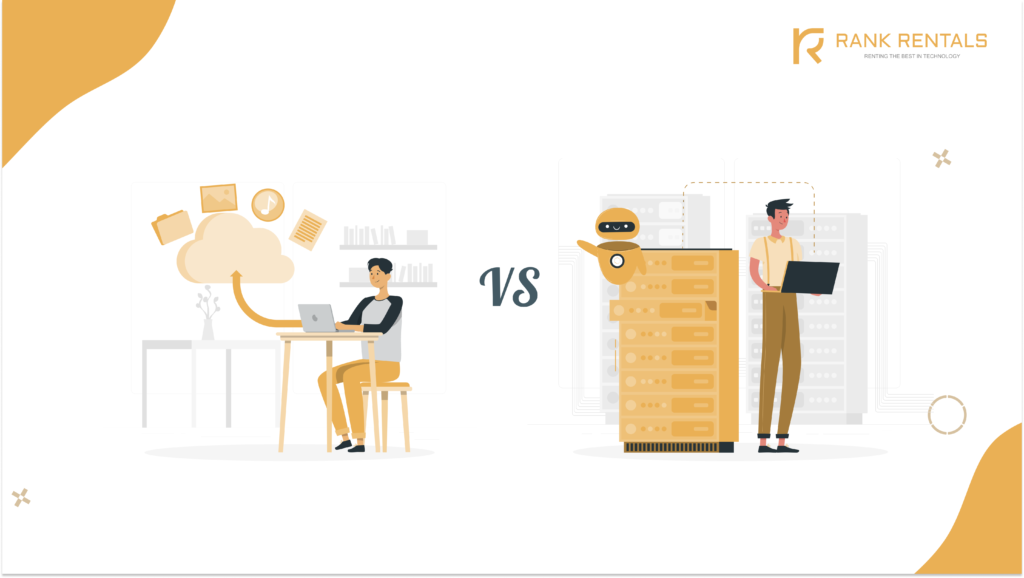
That is the moment the on-premise AI server vs cloud comparison becomes a strategic necessity.
Why Most Organisations Start With Cloud AI
Cloud platforms make early experimentation genuinely accessible. When teams are still validating a proof-of-concept, the ability to spin up GPU resources on AWS or Azure takes minutes rather than months.
In this phase, the AWS vs on-premise AI server debate is usually a short one. The cloud offers:
- Zero procurement lead times: No waiting for hardware shipments or data centre space.
- Elasticity: The ability to run a massive training job and shut it down immediately, paying only for the compute used.
- Testing variety: The freedom to try different GPU architectures to find what fits the specific model best.
For new initiatives and burst compute demands, cloud infrastructure is the right answer. The economics only shift when workloads transition from occasional to continuous.
Where the Cloud Bill Starts Climbing
Cloud GPU pricing is hourly, which feels manageable until jobs run around the clock. To put real numbers to it, an AWS EC2 P5 instance with 8x NVIDIA H100 GPUs was priced at approximately $98.32 per hour in early 2025. While market shifts in mid-2025 led to significant price reductions, even at a 40 percent discount, a sustained workload running 24/7 accumulates costs that can rival the purchase price of a server in under a year.
Beyond baseline compute, the AI workload cost comparison between cloud and on-premise is often decided by operational expenses that catch teams off guard:
- Data egress: Moving large datasets out of the cloud costs roughly $0.09 per GB on AWS. At petabyte scale, this becomes a significant recurring cost.
- Premium storage: Fast NVMe storage required to feed high-end GPUs carries a steep monthly premium in cloud environments.
- Underutilisation: Paying for an instance that is idling during a debugging session is essentially burning budget with nothing to show for it.
Understanding Total Cost of Ownership for AI Servers
When evaluating the total cost of ownership for AI servers, the math shifts from operating expenditure to capital expenditure. An enterprise-grade 8x NVIDIA H100 server is a significant investment, often exceeding $250,000 for hardware alone.
However, recent 2025 and 2026 TCO analyses suggest the breakeven point is shrinking. For organisations with high-utilisation inference or training workloads, on-premise hardware can pay for itself in:
- 11 to 12 months when compared to on-demand cloud pricing
- 20 to 22 months when compared to three-year reserved cloud instances
The critical variable is utilisation. Research indicates that on-premise becomes the mathematically superior choice when GPU utilisation consistently exceeds 60 percent over the hardware’s lifespan. Below this threshold, the flexibility of cloud justifies its premium. Above it, the savings compound every month.
Operational Factors Beyond the Price Tag
Cost is the primary driver, but several operational factors influence the decision:
Data locality and security: For many mid-market and enterprise firms, training data is core intellectual property. Keeping it on-premise reduces security risk and eliminates the cost and latency of moving large datasets into a cloud environment.
Predictable compute availability: Cloud GPU capacity can become constrained during periods of peak global demand. Owning infrastructure means engineering teams have dedicated access to the compute they need, regardless of market availability.
Financial forecasting: Finance teams generally prefer a known capital cost over an unpredictable monthly variable. On-premise infrastructure converts surprise cloud spikes into a predictable depreciation schedule.
The Middle Path: When Renting an AI Server Makes Sense
There is a strategic middle ground that solves a specific problem well: cloud has become too expensive, but the capital commitment of ownership feels too high.
Renting an AI server gives businesses access to dedicated, high-performance compute without committing to a permanent infrastructure footprint. At Rank Computers, this pattern comes up consistently. Organisations that have outgrown cloud economics but are not yet ready to commit to a long-term data centre investment.
Renting tends to make the most sense when:
- Workloads are tied to a specific 6 to 12 month project timeline
- The team needs to validate exact compute requirements before a major purchase
- High-performance GPU access is needed but keeping costs in the operating expenditure column is a priority
Before the Next Infrastructure Decision
The on-premise versus cloud decision does not have a universal correct answer. It has a current answer, based on where the organisation is in its AI journey.
If GPUs are running consistently, data transfer fees are mounting, and the finance team is asking for more predictability, it is likely time to look beyond the cloud console. Cloud is the right starting point for most AI programmes. On-premise is often the right long-term destination for the ones that scale.
The goal is to align compute capacity with how AI workloads actually run inside the organisation. Getting that alignment right is usually worth far more than the savings on this month’s cloud bill.