
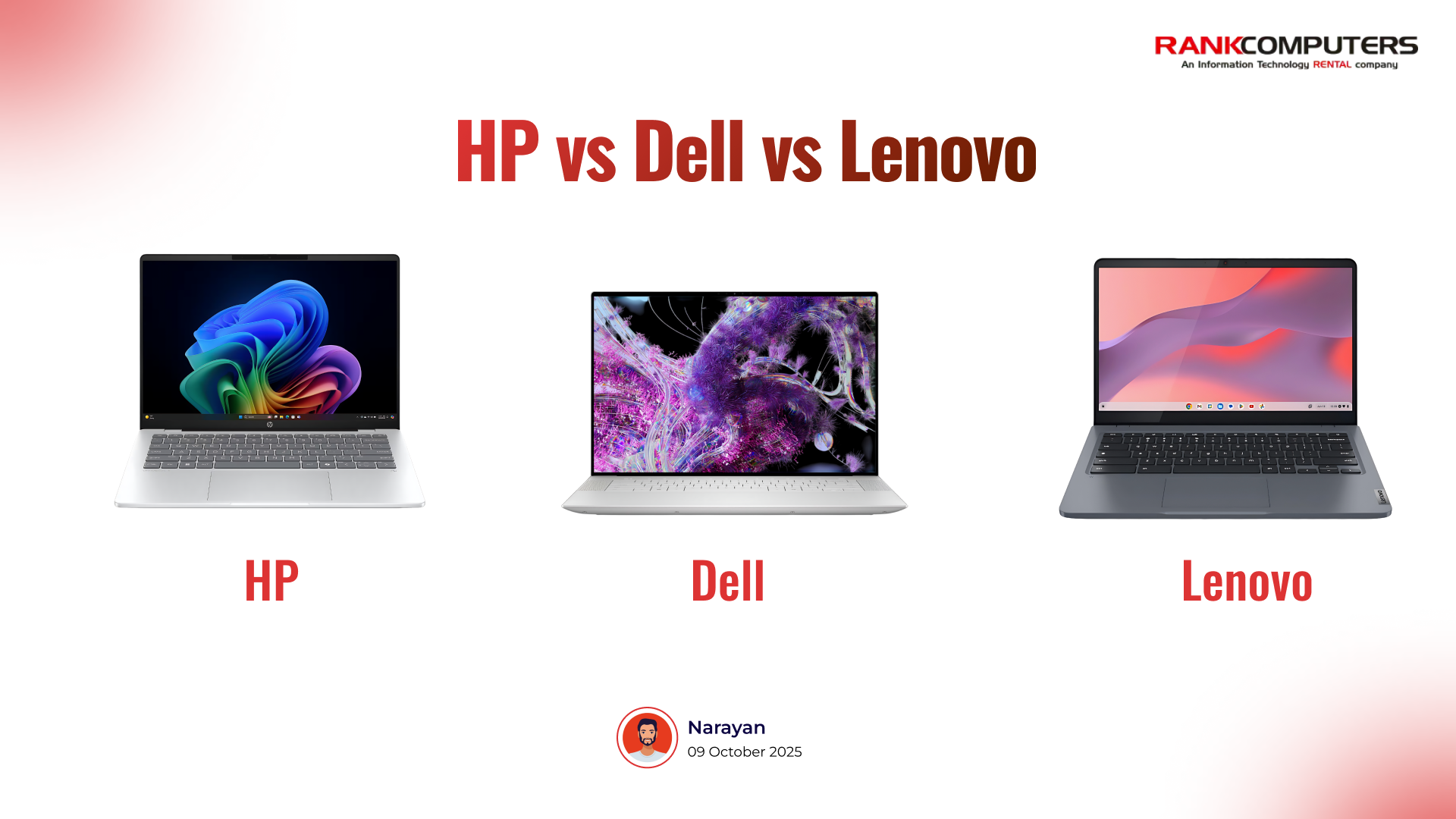
HP, Dell, and Lenovo together account for nearly half of all laptops sold globally. They’ve held that position for years – not because of marketing spend alone, but because each has built a genuinely distinct identity. HP leans into design and range. Dell has made reliability and service synonymous with its name. Lenovo built its reputation on productivity and durability, particularly through the ThinkPad series.
For individual buyers, the choice is mostly about personal preference. For businesses procuring devices for a team – whether buying or renting – the decision carries more weight. You’re choosing a platform that your IT team will manage, your employees will depend on, and your budget will absorb. Getting it right matters more than picking a favourite brand.
This guide breaks down what each brand actually offers in a business context, where they hold up, and where they fall short.
HP
HP’s strength has always been its range. From entry-level productivity machines to high-end workstation laptops, the catalogue covers more ground than most brands attempt. That breadth is both an advantage and a complication – not every HP line is built to the same standard, and choosing the right series matters more with HP than with the other two.
The lineup that matters for businesses
HP’s business-relevant range sits primarily across three lines. The EliteBook is HP’s enterprise flagship – slim, well-built, and designed for professionals who need a reliable machine that travels well. The ProBook sits a tier below, offering solid performance and durability at a more accessible price point, making it a common choice for team-wide deployments. The ZBook is HP’s workstation line, built for engineers, architects, and creative professionals who need serious processing and graphics capability in a portable form factor.
For most standard office deployments, the HP ProBook 440 or 450 G-series is the practical starting point – well-specced, competitively priced, and widely available. For executives or client-facing professionals who want something more refined, the EliteBook 840 series is worth looking at specifically.
The consumer lines – Pavilion, Envy, Spectre – are worth knowing about, but they’re generally not the right choice for business procurement. Build quality and repairability vary, and enterprise-grade manageability features are largely absent from these ranges.
Display and design
HP consistently produces strong displays, particularly at the mid and premium tiers. The EliteBook range offers sharp, colour-accurate panels that hold up well for everyday professional use. The Spectre line pushes into premium OLED territory, though it’s better suited to individual professionals than fleet deployments.
Aesthetically, HP tends toward modern and refined – thinner profiles, metallic finishes, cleaner lines than Lenovo’s business range. For client-facing roles where appearance carries some weight, HP often comes out ahead.
Price ranges
The ProBook range typically starts around ₹55,000–₹65,000 for a Core i5 configuration with 8GB RAM and 512GB SSD. The EliteBook range sits higher, generally between ₹80,000 and ₹1,20,000 depending on generation and spec. ZBook workstation laptops start around ₹1,20,000 and go significantly higher for GPU-heavy configurations.
Where HP falls short
Build quality is inconsistent across the range. An EliteBook and a Pavilion are genuinely different products in terms of durability and finish – but they carry the same brand name, which can create confusion during procurement. Battery life on budget and mid-tier models tends to disappoint. HP’s after-sales service in India, while improving, is not yet as reliable or consistent as Dell’s.
HP is a strong choice when you need a capable, well-designed fleet at mid-range pricing, particularly for office-based teams. The ProBook range offers good value for standardised business deployments.
Dell
Dell’s reputation in enterprise IT is not accidental. For decades, the brand has prioritised the things that matter most to IT departments and procurement teams: consistent build quality, manageable hardware, and proactive service infrastructure. It costs a little more, and it tends to be worth it.
The lineup that matters for businesses
The Latitude is Dell’s core business laptop – designed specifically for enterprise environments with manageability, security, and longevity in mind. IT administrators will find familiar BIOS-level controls, solid driver support, and options for remote management. For most business deployments, the Latitude is the sensible default.
For business fleet deployments specifically, the Dell Latitude 5000 series is the natural starting point – the 5440 and 5490 are current-generation models that balance performance, weight, and price well. For individual high-performance users, the XPS 13 or XPS 15 is the obvious choice. It is excellent hardware, often compared favourably to MacBook Pros, and suits individual high-performance users rather than fleet deployments.
The Inspiron handles Dell’s consumer and SMB market. It’s sturdier than HP’s equivalent lines and offers better value than the Latitude for businesses that don’t need enterprise-grade management features.
Service and support in India
This is where Dell genuinely separates itself from the competition. Dell’s service infrastructure in India is extensive – service centres are accessible across major cities, on-site warranty options are available, and the overall support experience is more consistent than what HP or Lenovo typically deliver at a comparable tier. For businesses where device downtime is a real operational cost, this is not a small consideration.
Price ranges
The Inspiron line starts around ₹50,000–₹65,000 for a standard business configuration. Latitude models – the more appropriate choice for enterprise deployments – typically range from ₹65,000 to ₹95,000 for Core i5 and i7 configurations. The XPS range starts around ₹1,00,000 and moves upward from there.
Where Dell falls short
Price. Dell Latitude models consistently cost more than comparable HP ProBooks or Lenovo ThinkPads. Some Inspiron models can feel heavier and bulkier than equivalent machines from HP and Lenovo. For businesses that prioritise typing experience – developers, writers, analysts – the keyboard quality doesn’t match what Lenovo’s ThinkPads deliver.
Dell is a strong choice when service reliability matters, you’re deploying to a team where downtime is costly, or you need enterprise-grade support infrastructure. It’s the most defensible choice for IT managers who need things to just work.
Lenovo
Lenovo’s business identity was inherited from IBM when it acquired the ThinkPad line in 2005. What came with that acquisition was more than a product – it was a philosophy: build laptops that hold up under real-world conditions, that prioritise the experience of the person actually using the machine, and that don’t sacrifice function for form.
That philosophy still defines the ThinkPad today.
The lineup that matters for businesses
The ThinkPad is the core of Lenovo’s business offering and one of the most recognised product lines in enterprise IT. Models like the ThinkPad L-series and E-series offer excellent value for standard business deployments. The T-series and X-series move upmarket in terms of build quality and performance. All ThinkPads share the same design language, reliability standards, and approach to durability.
For general staff deployments, the ThinkPad E14 is the natural starting point – current-generation performance at a price that makes fleet procurement practical. For mid-senior roles or heavier workloads, the ThinkPad T14 is the step up worth considering.
The ThinkBook line sits between the ThinkPad and consumer range – a more modern aesthetic with solid business credentials, popular with startups and growing businesses that want professional-grade hardware without the traditional ThinkPad look.
The IdeaPad and Yoga lines serve the consumer and prosumer market. They’re competent machines, but they lack the build standards and enterprise manageability of the ThinkPad range.
Durability and reliability
ThinkPads are tested to MIL-SPEC standards – covering temperature extremes, humidity, dust, vibration, and drop resistance. For teams that travel frequently, work in variable environments, or simply need hardware that holds up through years of heavy use, ThinkPads have a well-documented track record. The build quality is consistent across the range in a way that HP’s catalogue isn’t, and the long-term reliability is one reason IT managers return to Lenovo repeatedly when standardising a fleet.
Price ranges
The ThinkPad E-series – the entry point for business deployments – typically falls between ₹58,000 and ₹82,000 for standard configurations with 16GB RAM and 512GB SSD. The T-series, suited for senior or more demanding users, ranges from ₹85,000 to ₹1,18,000. The premium X1 Carbon sits between ₹1,40,000 and ₹2,00,000.
Where Lenovo falls short
Design. ThinkPads are functional and purposeful, but they don’t win aesthetic comparisons with HP’s Spectre or Dell’s XPS. For businesses where device appearance matters for client or brand perception, Lenovo’s business range can feel plain. Customer service quality also varies more than Dell’s – in some regions and tiers, the support experience is inconsistent.
Lenovo is a strong choice when you need durable, reliable hardware at good value, particularly for technical teams, field staff, or any role where the device sees sustained, demanding daily use.
Direct Comparison: HP vs Dell vs Lenovo
Direct Comparison: HP vs Dell vs Lenovo
| HP | Dell | Lenovo | |
|---|---|---|---|
| Design | Modern, varied across lines | Sleek at premium, functional otherwise | Functional, business-first |
| Build Quality | Inconsistent across range | Consistently solid | Exceptional in ThinkPads |
| Keyboard | Average | Good | Good (ThinkPad) |
| Display | Strong at mid and premium tiers | Good across range | Good, excellent at premium |
| After-Sales (India) | Improving, still inconsistent | Best in class | Varies by region and tier |
| Business Manageability | Strong in EliteBook/ProBook | Excellent in Latitude | Excellent in ThinkPad |
| Price | Wide range, accessible entry | Higher on average | Strong value, especially ThinkPad E/L |
| Best For | Office teams, client-facing roles | Enterprise deployments, service-critical environments | Technical teams, field staff, value-focused deployments |
Which Brand Fits Which Business Scenario?
Rather than a generic “pick this if you want that” summary, here are the scenarios that actually come up in business procurement decisions.
You’re equipping a sales or client-facing team: Appearance matters. Portability matters. The devices will be used in meetings, presentations, and client environments. HP’s EliteBook or ProBook range works well here – professional look, good displays, manageable weight.
You’re deploying laptops across a large team and need consistent IT support: Dell Latitude is the default choice for a reason. Standardised hardware, excellent driver support, strong service infrastructure in India, and the lowest risk of variation across a fleet.
You’re setting up a development or engineering team: Lenovo ThinkPad. The keyboard quality alone is worth it for people who code for eight hours a day. Combine that with durability and MIL-SPEC testing, and it’s the obvious choice for technical teams.
You need devices for field staff or frequent travellers: Again, ThinkPad – the durability testing and build standards make a real difference when devices are being carried daily, used in varied environments, or handled less carefully than office hardware.
You need high-performance machines for design, video, or 3D work: HP ZBook for portable workstation requirements. Dell XPS or Precision for professionals who want premium performance with strong service backing.
You need reliable machines for a short-term project or temporary expansion: This is where renting makes more practical sense than buying – and all three brands are available on rental from Rank Computers.
HP, Dell, and Lenovo Laptops on Rent – Rank Computers
Rank Computers has been supplying IT rentals to businesses for over three decades. What sets us apart is not just the inventory but the service:
- Latest Devices: Access newly launched HP, Dell, and Lenovo laptops without waiting for procurement cycles.
- Full Support: Every rental comes pre-configured and maintained, reducing downtime.
- Flexible Tenures: Daily, weekly, monthly, or long-term rentals depending on your project.
- Range Beyond Laptops: In addition to HP, Dell, and Lenovo laptops, we also provide servers, desktops, Macs, iPhones, and routers.
For businesses, this means you can focus on operations while we handle the IT backbone.
Get in touch with our team to discuss what you need.