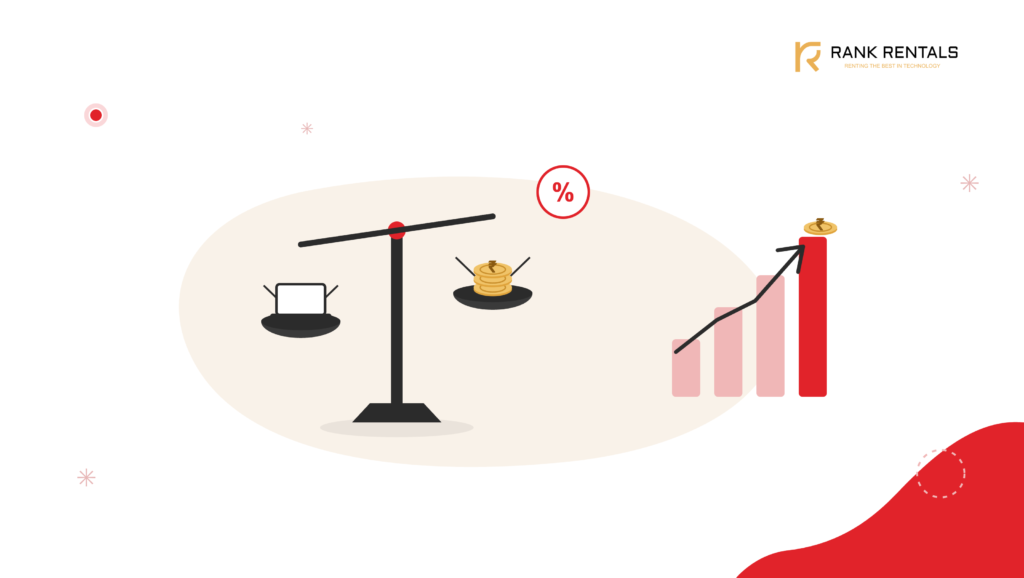

Most businesses make the rent versus buy decision the same way. They put the purchase price of the laptops next to the monthly rental figure, do a rough multiplication, and pick whichever number looks smaller. It feels like a sensible comparison. It is also the wrong one.
The invoice price is the least interesting number in this decision. What actually determines the cost of owning or renting IT equipment in India is what happens after tax, after cash flow, and after the hardware starts losing value the day it is switched on. Once a finance team looks at it through that lens, the comparison often lands somewhere different from where the sticker price suggested. This is not really a hardware question at all. It is an accounting one.
A short note before we start. What follows is general information to help you frame the decision, not tax advice. Rates, thresholds, and rules change, and how they apply depends on your specific business. Treat this as the conversation to have with your chartered accountant, not a substitute for it.
The Sticker Price Is the Least Interesting Number
When you buy a laptop, the cost does not end at the purchase. That machine becomes a capital asset. It sits on your balance sheet, it depreciates, it needs maintenance, it eventually has to be disposed of or sold at whatever the used market will pay, and for its entire life it represents capital you committed on day one and cannot easily get back.
When you rent the same laptop, the cost is a predictable monthly expense that covers the hardware, usually the support, and often the replacement if it fails. Nothing sits on the balance sheet. No capital is locked. No resale problem waits at the end.
Those are two very different financial shapes, and comparing them fairly means looking at four things the sticker price hides: GST, income tax treatment, cash flow, and the costs that never appear on any invoice.
GST: Closer Than the Sales Pitch Suggests
There is a common belief that renting saves you the GST you would pay on a purchase. For most businesses, that is simply not true, and it is worth being honest about.
Buying a laptop or computer attracts 18% GST. Renting IT equipment also attracts 18% GST, charged on the rental, under the leasing and rental services classification. So the headline rate is the same either way.
More importantly, a GST registered business under the regular scheme can claim input tax credit in both cases. The GST you pay on a purchase is claimable, and the GST you pay on rentals is claimable too, as long as the equipment is used for business and your supplier is compliant with their filings. For a registered business, GST is broadly neutral between renting and buying.
Where the GST point does matter is cash flow and registration status. On a large purchase, you pay the full 18% upfront and then wait to recover it through the credit cycle. On rentals, the GST is spread across the monthly payments, in step with the credit you claim. And for a business on the composition scheme, or one not registered, input tax credit is not available at all, which changes the picture entirely. If someone sells you renting purely on saving GST, ask them to show you the working.
Income Tax: Where the Real Difference Lives
This is the part that actually moves the needle, and it comes down to timing.
When you buy IT equipment, you cannot deduct the whole cost in the year you buy it. The machine is capitalised and written off gradually through depreciation. Computers, laptops, and similar hardware depreciate at 40% on a written-down value basis under the Income Tax Act, which means you recover the cost across several years, a shrinking amount each year, never quite reaching zero. There is also a rule that if the asset is put to use for less than 180 days in the year you buy it, you can only claim half the depreciation that first year. In short, ownership gives you the deduction slowly.
When you rent, the rental payment is a business expense. It is fully deductible in the same year you incur it, as revenue expenditure, the same way you would treat any other operating cost. There is no multi-year depreciation schedule to track, no block of assets to maintain in your books, no disposal adjustment to calculate later. You spend it, you deduct it, that year.
For a growing business, that timing difference is not academic. A full deduction this year is worth more than the same deduction spread thinly across the next five, and the simplicity of expending a rental rather than managing depreciation across a fleet has a real administrative value of its own.
Capital Locked Versus Capital Working
Every rupee spent buying hardware is a rupee that is no longer available for the business itself. That is the quiet cost of ownership that a purchase price never shows.
Buying is capital expenditure. You commit a large sum upfront, and that money is now sitting in depreciating equipment rather than in inventory, hiring, marketing, or working capital. For most businesses, hardware is not where capital earns its best return. It is simply where a lot of it ends up parked.
Renting is operating expenditure. Instead of one large outflow, you have a predictable monthly cost that maps neatly to the period the equipment is actually used. The capital you would have sunk into laptops stays in the business, doing the work the business is actually good at. This is the entire logic behind why so many companies are choosing access over ownership, and why a growing number of startups deliberately set up without heavy capital expenditure. It is not that they cannot afford to buy. It is that buying is rarely the best use of the money.
The Costs That Never Appear on the Invoice
The purchase price also leaves out the expensive part of ownership, the part that arrives later.
Hardware becomes obsolete. A laptop that was well specified three years ago is a support headache today, and the refresh cycle that ownership commits you to is a recurring cost most budgets underestimate, which is exactly how constant refreshes quietly drain an IT budget. There is the maintenance you now own, the downtime when a machine fails and there is no replacement waiting, the staff time spent managing all of it, and finally the disposal problem, selling ageing hardware at a fraction of its cost or paying to recycle it responsibly.
Renting folds most of these into the arrangement. Support and replacement are typically part of the service, obsolescence is the rental company’s problem rather than yours, and at the end you simply hand the equipment back. None of this shows up when you compare a purchase price to a monthly rate, but all of it is real money.
One Compliance Point Not to Miss: TDS on Rent
If you rent equipment, there is a tax obligation that comes with it, and it is worth getting right.
Rental payments for plant, machinery, and equipment attract tax deducted at source at 2% under Section 194I, once your total rent to a supplier crosses the annual threshold, which stands at ₹6 lakh following the change announced in Budget 2025. The mechanics are straightforward: you deduct the 2%, deposit it, and account for it, but the consequence of ignoring it is not. Failing to deduct or deposit TDS can see a large part of the rental expense disallowed when your taxable profit is calculated, which turns a routine compliance step into an expensive oversight. Your accounts team will handle this comfortably once they know to, which is precisely why it belongs in the decision rather than as a surprise afterwards.
So, Rent or Buy?
None of this makes renting universally right or buying universally wrong. The honest answer depends on the equipment and the situation.
Buying tends to make sense for stable, long-life infrastructure that your business will use continuously for years, where the workload is settled, and the hardware will not date quickly. If a machine will be run hard, kept for its full useful life, and never needs to flex, ownership can be the reasonable call.
Renting tends to win wherever there is flexibility, change, or growth involved. Project teams and temporary requirements. Fast-moving or fast-obsolescing equipment. Businesses that would rather keep capital working than parked. Situations where the full deduction this year, the predictable monthly cost, and the absence of a resale problem matter more than owning the asset outright. Many businesses land on a blend, owning the stable core and renting everything that moves, which is often the most efficient answer of all. Our wider take on why choosing IT rentals is an effective choice walks through where that line usually falls.
IT Equipment on Rent, from Rank Computers
Rank Computers has supplied IT equipment to businesses across India for over three decades. We rent laptops, desktops, workstations, servers, and Apple products on flexible terms, on daily, weekly, monthly, and long-term rental, with GST-compliant invoicing, pre-configured machines, on-ground support, and replacement cover across Mumbai and other major cities. If you want to work through the rent versus buy maths for your own requirement, and what it means for your books, get in touch with our team.
The Bottom Line
The businesses that get this decision right are not the ones that simply pick the smaller number. They are the ones who look past the sticker price to what the equipment actually costs after tax, after cash flow, and after obsolescence. GST is broadly neutral for a registered business. The income tax advantage of a full, immediate deduction sits with renting. The cash flow advantage of keeping capital working sits with renting too. And the hidden costs of ownership, obsolescence, maintenance, and disposal rarely make it into the comparison at all. Work the decision through with your accountant using the real numbers, and rent versus buy stops being a guess and becomes a calculation.