
Most businesses approach IT rental vendor selection the same way they’d approach buying office supplies. Collect a few quotes, compare the monthly rates, check whether the devices are available, and go with the lowest number that looks reasonable.
It’s an understandable instinct. But it’s also how businesses end up with a vendor they regret.
The problems rarely show up in the quotation. They show up three weeks into a deployment when a replacement takes four days instead of four hours, or when a project scales and the vendor can’t match it.
Hardware is the easy part of IT rentals. What you’re actually evaluating is everything around it.
You’re Not Just Renting Hardware
When a business rents laptops or workstations, the device itself is almost incidental. What you’re really paying for is the vendor’s ability to get the right equipment to the right people on time, keep it running, replace it when something fails, and scale the arrangement when your requirements change.
A vendor with a large catalogue but slow deployment, poor support, or limited inventory depth isn’t actually offering you much. The hardware exists. The service around it doesn’t.
That distinction shapes how the evaluation should be structured – not around what the vendor has, but around what they can reliably do.
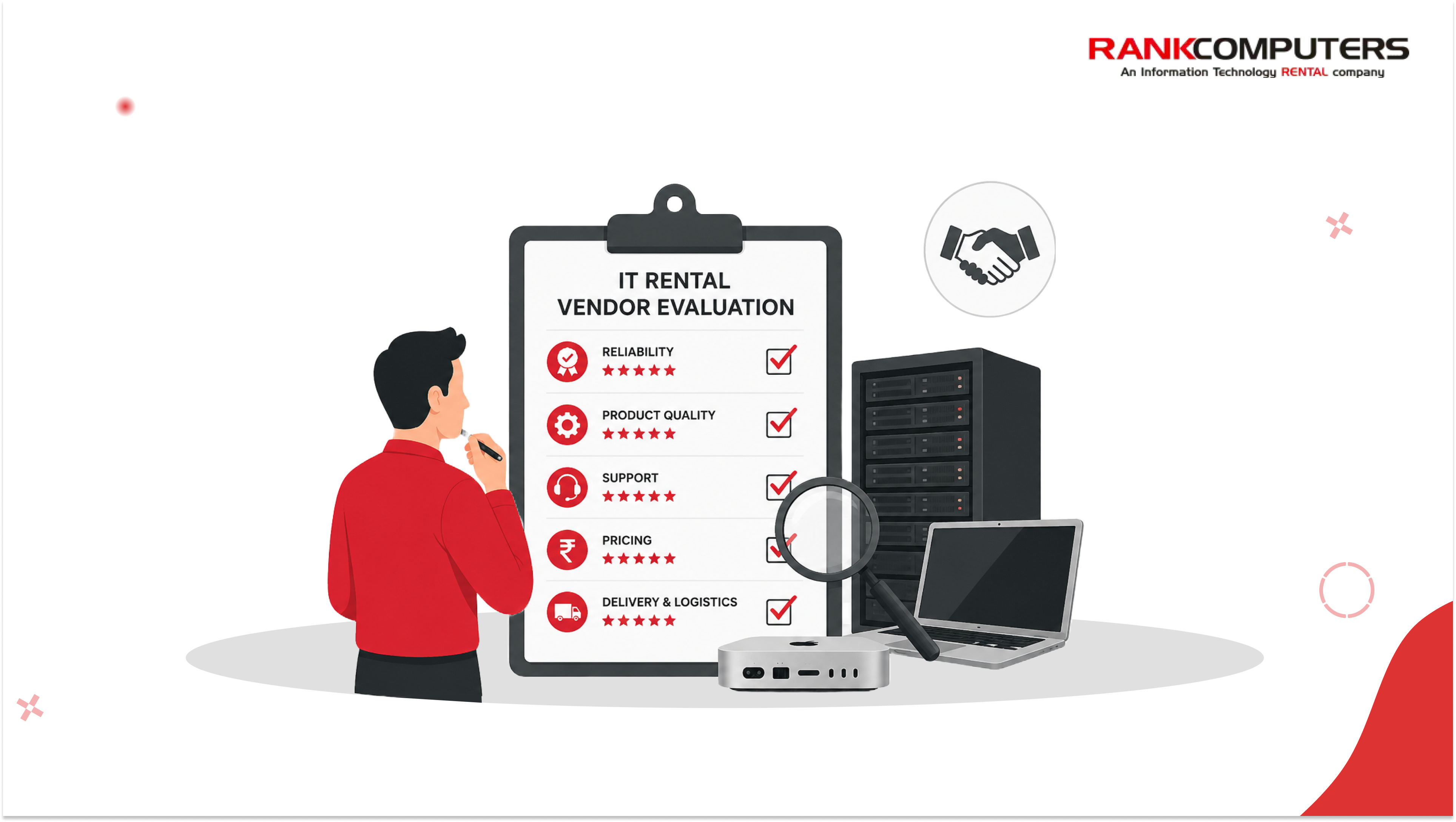
Before You Sign: What to Evaluate
Deployment capability
The first real test of a vendor is how quickly they can get devices to you. This matters more than most businesses anticipate at the quotation stage.
A vendor who can deploy 10 laptops in three days is very different from one who needs two weeks. For businesses onboarding new employees, opening a new location, or running a time-sensitive project, that gap has direct operational consequences.
Ask specifically: what is the typical lead time from confirmed order to deployment? Can they handle urgent or same-day requirements? Have they supported deployments at the scale and timeline you need?
Inventory depth
Most vendors can fulfill a modest initial order. The question is what happens when requirements grow.
A business that starts with 15 laptops may need 40 within a few months. A project team that expands mid-engagement may need 10 additional workstations at short notice. A new branch office may need to be equipped within days.
If the vendor’s inventory can’t support that kind of movement, they become a bottleneck at exactly the moment you need flexibility.
Ask how many units they typically have available across the device types you need, and whether they can commit to scaling the arrangement during the rental period.
Device preparation
Not all rental devices arrive in the same condition, and the difference matters operationally.
Devices that arrive tested, charged, cleaned, and pre-configured with required software mean employees can get to work immediately. Devices that arrive needing setup, configuration, or troubleshooting cost time – and at scale, that time adds up quickly.
Ask whether devices are tested and verified before dispatch, whether software can be pre-installed, and how the vendor handles configuration for larger deployments.
Support structure
This is the factor most businesses evaluate least carefully before signing – and regret most afterward.
Understand the support structure before you need it. Is there a dedicated point of contact? Are support services handled directly by the vendor or outsourced? What are the documented response times? If a device fails on a Monday morning, what does the process look like and how long does it realistically take?
The answers reveal far more about a vendor than the monthly rental rate does.
During the Rental: What Good Looks Like
A vendor relationship that works well tends to be simple. Devices arrive on time, work as expected, and get replaced quickly when something goes wrong. Scaling up is handled without friction. Billing is accurate. Communication is straightforward.
That predictability is worth paying for – and it’s genuinely difficult to assess from a quotation alone.
The indicators to watch for once a rental is underway: how quickly issues get resolved, whether replacements require significant follow-up, and whether the vendor is proactive or reactive when problems arise. Choosing well here solves half the problem. The other half is internal – once a fleet is deployed across multiple offices, it needs its own structured approach to stay manageable.
Businesses that have worked with a reliable vendor for an extended period often describe it simply as infrastructure they don’t have to think about. That’s the benchmark worth aiming for.
When Requirements Change: Evaluating Flexibility
Business requirements change. Teams grow, projects expand, seasonal workloads spike, new offices open. An IT rental arrangement that can’t adapt to those changes stops being useful and starts creating friction.
When evaluating vendors, think one step beyond the current requirement.
Can the vendor support additional devices mid-contract? Can they accommodate different device types if your needs shift – workstations instead of laptops, or Mac alongside Windows? Can they support multiple locations if you expand? Are rental terms flexible enough to scale up or down without significant penalties?
A vendor that can only fulfill the exact requirement you have today may work for a one-time, fixed engagement. For anything involving growth or change, flexibility in the vendor relationship becomes as important as the hardware itself.
The Questions Worth Asking Before You Decide
Across all of the above, these are the questions that tend to surface the most useful information:
- How quickly can you deploy devices from confirmed order?
- What happens if a device fails – what is the replacement process and timeline?
- How many units do you have available across the device types we need?
- Can inventory be scaled during the rental period if our requirements grow?
- Can you support multiple locations?
- Are devices pre-configured and tested before delivery?
- Who is our point of contact once the rental is active?
- Is support handled directly by your team?
A vendor who answers these questions specifically and confidently is telling you something. One who hedges, generalises, or redirects to the quotation is also telling you something.
The Cheapest Quote Is Rarely the Lowest Cost
It’s worth saying directly: the lowest rental rate and the lowest overall cost are not the same thing.
A delayed deployment that pushes back onboarding by a week has a cost. A device that takes three days to replace during a project has a cost. A vendor who can’t scale when you need to hire quickly has a cost. None of these appear in the rental agreement, but all of them affect how the business operates.
The vendors that look expensive at the quotation stage often look considerably more reasonable once you factor in what a support failure or deployment delay actually costs.
Pricing is a legitimate consideration. It just shouldn’t be the first one.
HP, Dell, and Lenovo Equipment on Rent – Rank Computers
Rank Computers has been providing IT equipment rentals to businesses across India for over three decades. We stock laptops, desktops, workstations, servers, and Apple products across a range of configurations – available on daily, weekly, monthly, and longer-term rental terms.
Every device is pre-configured and ready to deploy. We carry inventory across HP, Dell, Lenovo, Apple, and other major brands, and can support deployments across Mumbai and other major cities.
If you’re evaluating IT rental vendors and want to understand what we offer, get in touch with our team.